Get Free Ebook Culturing Life: How Cells Became Technologies
Get Free Ebook Culturing Life: How Cells Became Technologies
When you have actually chosen that this is likewise your much-loved book, you have to examine and obtain Culturing Life: How Cells Became Technologies sooner. Be the to start with people and also accompany them to enjoy the info associated about. To obtain even more referral, we will reveal you the connect to get and also download guide. Even Culturing Life: How Cells Became Technologies that we offer in this web site is type of soft file book; it does not mean that the material will be lowered. It's still to be the one that will certainly influence you.
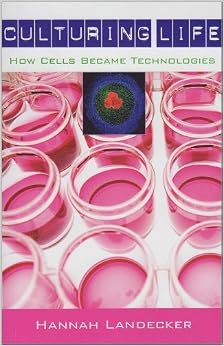
Culturing Life: How Cells Became Technologies

Get Free Ebook Culturing Life: How Cells Became Technologies
Exactly how a concept can be obtained? By staring at the superstars? By checking out the sea and looking at the sea weaves? Or by checking out a publication Culturing Life: How Cells Became Technologies Everyone will certainly have certain characteristic to get the motivation. For you which are passing away of publications and also always get the motivations from publications, it is actually wonderful to be right here. We will certainly show you hundreds compilations of guide Culturing Life: How Cells Became Technologies to check out. If you similar to this Culturing Life: How Cells Became Technologies, you can likewise take it as all yours.
If you actually wish to be smarter, analysis can be among the whole lots means to evoke and understand. Lots of people who like analysis will certainly have more understanding and experiences. Checking out can be a method to acquire information from business economics, politics, scientific research, fiction, literary works, religious beliefs, and also lots of others. As one of the part of book groups, Culturing Life: How Cells Became Technologies constantly ends up being the most desired publication. Many individuals are definitely looking for this book. It indicates that several love to read this type of publication.
The book is a book that can help you discovering the reality in doing this life. In addition, the advised Culturing Life: How Cells Became Technologies is likewise composed by the specialist author. Every word that is provided will certainly not burden you to think roughly. The means you enjoy reading may be begun by another book. Yet, the means you should read book time and again can be started from this favored book. As reference this publication also offers a better principle of how to draw in the people to check out.
To deal with this condition, many other people also try to get this book as their reading now. Are you interested? Pick this best book to offer today, we offer this book for you because it’s a kind of amazing book from professional and experienced author. Becoming the good friend in your lonely without giving boredom is the characteristic of Culturing Life: How Cells Became Technologies that we present in this website.
Review
In Culturing Life: How Cells Became Technologies, Landecker offers a history of the development of cell culture in biology that is sparkling with originality and insight. She has an anthropologist's eye for nodes of cultural significance even as her narrative arc is deeply historical. The book weaves a rich tapestry of biological, historical, and cultural connections. (Angela N. H. Creager, Associate Professor of History, Princeton University)Landecker hits exactly the right balance of interpretive analysis and presentation of substance. Her stories carry the more technical descriptions so that both are motivated and compelling. I thoroughly enjoyed reading this book and, moreover, I found it exciting. (Jane Maienschein, Regents' Professor and Parents Association Professor of Biology and Society)Culturing Life is a beautifully written, lucid account of the history of tissue culture, a technology that permits the isolation of cells from bodies, their continuous reproduction, and global distribution as immortalized cell lines. Landecker draws us into a world where the limits of biological plasticity are continually tested, cell fusion and cloning are commonplace, and biological time is transcended--in short, technological manipulation has forever transformed what it is to be biological. This book will rapidly become indispensable reading in the field of science and technology studies. (Margaret Lock, author of Twice Dead: Organ Transplants and the Reinvention of Death)In our age of cloning and stem cells, Landecker's challenging study does a real service as it locates the techniques and ideas, developed through time, which make these cell manipulations possible. Landecker charts the uncertain movement of cells from organisms (including humans) to the laboratory, moving beyond cell cultures to the expectations of biologists and to the philosophical and ethical issues that emerge as control over life becomes possible. Others have written histories of cell theory; here Landecker recovers the story of the cell practices that have transformed what we mean by life. (Everett Mendelsohn, Harvard University)A mere century ago, scientists didn't know how to culture cells in a medium and believed that cells couldn't live outside their parent organism. As Landecker reminds us, today we can hardly live without cell cultures, which are used for everything from routine medical tests to genetic engineering...She is a keen observer of scientific practice. (Publishers Weekly 2006-11-13)The discovery that it was possible to grow cells in a lab dish transformed them from being the immutable building blocks of individual bodies into plastic, malleable resources with a life of their own. In Culturing Life, anthropologist Hannah Landecker skillfully interweaves the scientific, historical, and cultural aspects of this transformation, and examines how cell culture challenges humanity's notions of individuality and immortality...An insightful and thought-provoking perspective on how technology has changed scientists' and society's understanding of life. (Claire Ainsworth New Scientist 2007-02-24)In the flood of instant comment on cloning and stem cells, we need the longer and deeper views of cellular technologies that only history can provide. Historians of science have written much about the nineteenth-century advent of cell theory, but genes and molecules stole the limelight in the twentieth...Culturing Life by Hannah Landecker is a small book that does much to fill that large gap...[An] original book...[A] stimulating reconstruction of the cultures that gave us cultured cells. (Nick Hopwood Nature 2007-03-08)Few laymen realize that scientists first fused cells from different species as far back as the 1960s, as Ms. Landecker describes...The level-headedness that can be gained from historical perspective is the value in reading Ms. Landecker's account. (The Economist 2007-03-31)Hannah Landecker's fascinating, beautifully written account of the history of cell culture restores the sense of wonder felt by the first scientists who grew living cells apart from organisms and by the people who read about their achievements in scientific journals, popular magazines, and newspapers. But this book does much more than that; it sheds a unique light on the history of biology in the 20th century, the rise of biotechnology, and our understanding of what life is...By reflecting on the catastrophic, artificial, and radically new variety of life that arises in the laboratory, Landecker opens new ways to articulate the ideas of the French philosopher of science Georges Canguilhem about the distinction between the normal and the pathologic. Cultured cells bring into question our understanding of the biologic, but their infinite plasticity, as Landecker eloquently shows, often unfolds in the normative space of medicine. (Ilana Löwy New England Journal of Medicine)With her book Culturing Life, Hannah Landecker contributes an important chapter to the recent history of laboratory fractals. Her elegantly written and well-documented narrative demonstrates how, within 20th-century biological laboratories, a whole range of vessels and containers were used in order to store, breed, study, and manipulate cells and tissue outside the body of organic individuals: from hanging-drop preparations in the 1910s to tissue culture flasks in the 1930s and powerful freezers in the 1950s and 1960s....The great merit of this book is its demonstration that these spaces of knowledge also create and imply specific regimes of temporality. (Henning Schmidgen Project Muse Scholoary Journals Online)
Read more
About the Author
Hannah Landecker is Associate Professor of Sociology at University of California, Los Angeles.
Read more
Product details
Paperback: 288 pages
Publisher: Harvard University Press; 1 edition (March 30, 2010)
Language: English
ISBN-10: 0674034767
ISBN-13: 978-0674034761
Product Dimensions:
5 x 0.6 x 8 inches
Shipping Weight: 12.6 ounces (View shipping rates and policies)
Average Customer Review:
Be the first to review this item
Amazon Best Sellers Rank:
#1,119,427 in Books (See Top 100 in Books)
Culturing Life: How Cells Became Technologies PDF
Culturing Life: How Cells Became Technologies EPub
Culturing Life: How Cells Became Technologies Doc
Culturing Life: How Cells Became Technologies iBooks
Culturing Life: How Cells Became Technologies rtf
Culturing Life: How Cells Became Technologies Mobipocket
Culturing Life: How Cells Became Technologies Kindle
0 komentar